
The CALM Bottle Method®
The CALM Bottle Method® was developed to address feeding in its entirety.
Feeding is a complex task, involving many processes interconnecting all at once, some from within your baby, some external to them: cognitive development, relationships, physiological processes, environmental factors, and emotions, all at play together.
When we address feeding from this viewpoint, rather than as a behaviour to push through and correct, we can truly restore aversive feeding patterns.
The approach sits on four pillars: Connection, Alignment, Learning, Mastery. These work in sequence, each one making the next possible. Mastery, feeds you can trust day in, day out, is the final pillar, built up to with a specialist guiding the journey; It's an approach built on measurable outcomes.
The method was written by Laura Bottiglieri and developed through 12 years of specialist clinical practice in the Paediatric & Infant, Speech Therapy feeding space, treating bottle aversion, feeding refusal, and complex infant feeding difficulty.


Why It Exists
Working with bottle aversion for over a decade meant seeing the same pattern repeatedly: advice that focused only on getting more milk in, a different bottle, a stricter schedule, pushing through hunger (any parent of a baby with bottle aversion, knows that rarely works) without ever asking why feeding had become hard for that baby's body to manage in the first place. The key piece that is missing from nearly all the advice out there is how the feeding dynamic exists between parents and their babies.
The CALM Bottle Method® prioritises connection above all else because that is where feeding flourishes. Having a specialist who knows how to coach parents with clinical precision, at their most vulnerable and through one of the most difficult challenges of early parenthood is how transformation happens.
Why this matters
Up to 25% of infants experience feeding difficulties significant enough to disrupt daily routines. Where there's a medical, sensory, developmental, or reflux-related picture, that rises to 40–80%. A baby who associates feeding with distress is more likely to reduce intake and limit their cues, not because they won't feed, but because their system currently can't manage it.
In my own clinical experience, 90% of the families who access the CALM Bottle Method® with see a noticeable reduction in feeding distress within the first one to two weeks.
The impact of the CALM Bottle Method®
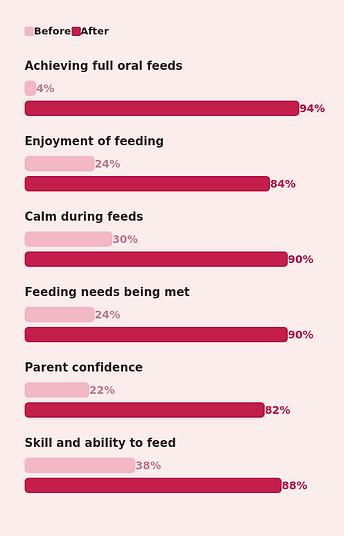
The CALM Bottle Method® is measured for its effectiveness using established paediatric dysphagia outcome measures (PaedD-TOM, Therapy Outcome Measures for Rehabilitation Professionals, Enderby & John, 2015).
Each area of feeding is scored out of 5, before and after. Below, that score is shown as a percentage of the maximum, so a score of 1 out of 5 reads as 20%, and a score of 4 out of 5 reads as 80%, giving a clear picture of where your baby started, and the impact of the method from there.
Here's what happens for families who access the CALM Bottle Method® through the Feeding Pathway that best meets their starting point.
Results:

How to access it
The CALM Bottle Method® is delivered through the Feeding Pathways, matched to how deep the difficulty runs, from early bottle refusal through to medically complex feeding needs. Parents ready to find out which pathway is right for their baby should book a First Step Feeding Consultation.
Professionals ready to have a new way of approaching aversion with the families in their care, including training or consultation, are welcome to enquire directly by sending Laura an email where we can discuss you or your team's specific needs.